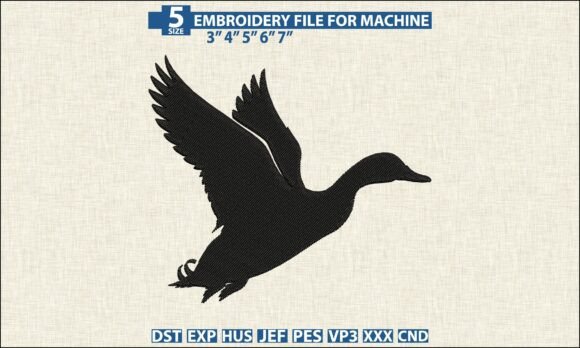
Flying Duck DST PES Embroidery Design
A Practical Review for Small Business Merchandise & Branded Patches
As an embroidery designer who’s developed and tested hundreds of machine embroidery designs for small business clients—from artisanal bakeries to outdoor gear startups—I approached the Flying Duck DST PES Embroidery Design with a very specific question: *Does this work as functional brand equity—not just decoration?* The answer, after testing across multiple substrates and use cases, is a qualified yes—but only when applied intentionally.
First Impression: Rustic Charm Meets Clear Visual Hierarchy
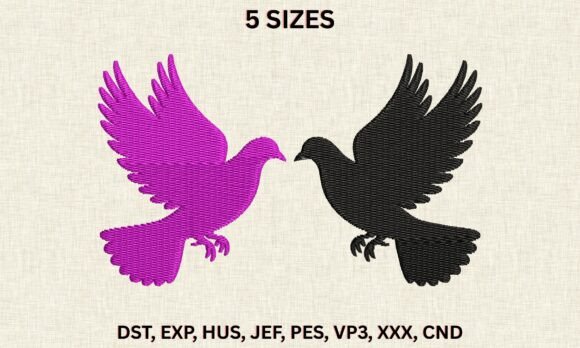
Right away, the Flying Duck DST PES Embroidery Design reads as friendly, outdoorsy, and quietly confident—not overly playful or cartoonish, but not stiff or corporate either. That’s valuable. For a small business—say, a local florist launching a “Wildflower & Waterfowl” seasonal collection or a pet brand specializing in duck-themed accessories—the design delivers instant nature association without needing text. It feels handmade in spirit but precise enough for professional embroidery execution. As a Birds-category design, it avoids cliché by focusing on motion (flight) and silhouette rather than literal detail, which translates well across scales and fabrics.
Where It Shines in Real Business Use
The Flying Duck DST PES Embroidery Design performs exceptionally well in these commercial contexts:
- Embroidered patches — Its clean outline and moderate stitch density hold up beautifully at 2.5"–3.5" sizes, especially when backed with twill or chenille for boutique merchandise or staff uniforms.
- Apron embroidery — Positioned on the chest or pocket flap, it adds warmth and authenticity to café, bakery, or craft studio branding without overwhelming the garment.
- Cap embroidery — On structured front panels (especially mid-crown caps), the flying posture reads clearly even at reduced scale—no distortion or lost definition.
- Tote bag design — Works as a subtle yet memorable accent near the handle seam or centered low on the front panel, reinforcing brand identity on reusable customer gifts.
- Custom apparel accents — Ideal for sleeve details on work shirts or back-of-neck highlights on lightweight tees used for event merch or pop-up shops.
- Product packaging accents — When stitched onto fabric tags, drawstring bags, or reusable gift wraps, it signals craftsmanship and aligns with eco-conscious values.
Because it’s delivered as a digital embroidery file in DST and PES formats, integration into commercial embroidery workflows is seamless—no conversion lag, no vector reinterpretation needed. That reliability matters when you’re juggling orders for 12 different small business clients in one week.
Where Caution Is Required
Not every application suits the Flying Duck DST PES Embroidery Design. Avoid using it:
- Below 2" in size—fine wing and tail details risk fill collapse or thread nesting, especially on textured fabric like canvas or heavy duck cloth.
- On highly curved surfaces (e.g., deep cap crowns or contoured tote gussets) without re-hooping and stabilizer adjustment.
- With ultra-low-contrast thread colors on dark uniforms—test black-on-navy or charcoal-on-black first; subtle gradients may disappear.
- In high-wash-frequency items (like restaurant aprons or daycare staff shirts) unless paired with high-tensile polyester threads and cutaway stabilizer.
- Alongside dense companion text (e.g., full business name + tagline)—its strength lies in standalone recognition, not typographic pairing.
Impact on Brand Identity & Customer Trust
This isn’t just a duck—it’s a signal. When customers see the Flying Duck DST PES Embroidery Design on your staff’s aprons or your tote bags, they subconsciously register consistency, intentionality, and care. That builds trust faster than any slogan. For Etsy sellers and handmade brands, it reinforces the “human-made” aesthetic while still feeling polished—a rare balance. And because it’s rooted in the Birds category but executed with modern minimalism, it avoids dating quickly. Unlike trend-driven motifs, this design supports long-term visual consistency across your small business merch ecosystem.
Essential Embroidery Designer Notes Before Production
Before stitching your first client order, do these six things:
- Run a printable mockup in black and white first—verify clarity of negative space and wing separation without color distraction.
- Test at your smallest intended patch size (e.g., 2.25") on actual fabric—check for thread breaks or under-stitching in the neck curve.
- Review thread color contrast on both light and dark base fabrics—some earth-tone palettes mute the silhouette more than expected.
- Inspect spacing between wingtip and body—if too tight, it may merge during stitching on stretchy or loosely woven materials.
- Confirm hoop size compatibility with your commercial embroidery machine—don’t assume standard 4x4 works without verifying file boundaries.
- Always test on real fabric with your intended stabilizer combo—especially for cap embroidery or apron embroidery, where tension shifts dramatically.
Finally, double-check licensing: ensure your purchase includes rights for commercial embroidery and resale of finished products. Many digital embroidery file marketplaces restrict usage unless explicitly stated—and small businesses can’t afford legal oversights.
Final Thought: A Strategic Asset, Not Just a Design
The Flying Duck DST PES Embroidery Design earns its place in your design assets library not because it’s flashy, but because it’s versatile, legible, and emotionally resonant. It bridges outdoor authenticity with boutique professionalism—making it ideal for businesses that want to stand out through subtlety, not saturation. Whether you’re building custom apparel for a new florist collective or creating limited-run patches for a local conservation fundraiser, this machine embroidery design delivers measurable value: stronger recognition, higher perceived product value, and quieter confidence in your brand story. Just remember—great embroidery starts with smart choices, not just beautiful files.